

Why Are We So Critical of Our Bodies? The Impact of Others' Opinions

A wrinkle. A scar. Hair on your legs. The shape of your belly. Cellulite.
There are parts of our bodies we could simply see for what they are. And yet, sometimes, they become things we feel the need to control, hide or change.
But who decided they were a problem in the first place?
Many of the standards we use to judge our bodies are learned over time, often without us even realising it.
Comments we heard growing up, beauty standards, advertising, social media, comparing ourselves to others: everything we see and hear around us can help shape the way we learn to see ourselves.
And little by little, someone else's perspective can become our own.
To better understand where body-related self-criticism comes from, why certain judgements stay with us and how we can regain a little freedom in the way we relate to our appearance, we explored the topic with Serenis, an online mental health clinic.
How we learn to see our bodies
A therapist from Serenis explains that our relationship with our bodies doesn't develop in a vacuum.
We grow up surrounded by images, comments, expectations and ideals that tell us, sometimes explicitly and sometimes more subtly, which physical features are considered desirable and which aren't.
Sometimes these messages are impossible to miss. Other times, they're much more subtle.
A comment about our weight. A joke about body hair. A compliment that comes just when we've lost weight. An advert where skin is always perfectly smooth. Or dozens of seemingly flawless bodies scrolling across our screens while we're sitting on the sofa in our pyjamas, eating biscuits.
Comparison isn't necessarily a bad thing: comparing ourselves to others is human nature.
The problem can arise when certain beauty standards gradually become internalised, until they turn into the criteria we use to judge ourselves.
At that point, we no longer need someone else to tell us that our bodies should look different.
We can start telling ourselves.
As the Serenis therapist explains:
“The image we have of our bodies doesn't come from a neutral perspective. It develops over time, shaped by our experiences, the comments we've received, family and cultural influences, and comparisons with others.
Some experiences can have a particularly strong impact: being mocked for our appearance, repeatedly hearing comments about our weight or a physical feature, or learning that a certain part of our body should be hidden.
Over time, these judgements can become internalised and shape the way we see ourselves, even when no one is saying those things to us anymore.”
Why do we become so critical of our bodies?
There's an interesting psychological mechanism that can help explain why certain body insecurities continue to take up so much space in our minds.
Imagine a very simple situation.
You look in the mirror and notice something about your body that you don't like.
An automatic thought pops into your head:
"It's too noticeable."
"I should cover it up."
"Other people are going to notice."
That thought makes you feel uncomfortable. And to ease that feeling, you might start doing certain things: checking yourself in the mirror again, changing your clothes, hiding that part of your body, comparing yourself to others or trying to “fix” it.
And maybe it works… at least for a little while.
The discomfort fades and you feel better.
But here's the thing: that very sense of relief can actually keep the cycle going. If hiding that feature made me feel better, I might become even more convinced that showing it would have been a problem.
And there we are, back in front of the mirror.
Serenis explains how this works:
“From a cognitive behavioural perspective, it's often not the physical feature itself that keeps the discomfort going, but the meaning we attach to it and the things we do to feel better. If I think ‘this part of my body mustn't be seen’, I might start checking it, hiding it, comparing myself to others or seeking reassurance.
These behaviours can reduce discomfort in the short term, but that very relief can reinforce the original belief: if hiding it made me feel better, then perhaps showing it really was dangerous or unacceptable. And the cycle starts all over again.”
Social media, comparison and body insecurities: how much do other people's opinions matter?
And then, of course, there's social media.
It's not the enemy, obviously. But it has multiplied the opportunities we have to compare our appearance with other people's.
The thing is, we're often comparing our everyday reality with carefully selected or curated images.
And even when we rationally know that what we see online doesn't represent the whole picture, it can still affect how we feel.
So other people's opinions can turn into an imaginary audience we carry around with us, even when no one is actually watching.
"Will people notice?"
"Can I go out looking like this?"
When that happens, we risk starting to see our bodies mainly from the outside: instead of asking ourselves how we feel, we focus on how we look to others.
When a beauty preference becomes a rule
Shaving or not shaving isn't a problem.
Wearing makeup or going without isn't a problem.
Wanting to change something about your appearance isn't a problem, just as there's nothing wrong with not wanting to change a single thing.
What really matters isn't so much what we choose to do, but how free and flexible that choice actually is.
“No choice exists completely outside the world we live in: our tastes, habits and ideas about what's beautiful or presentable are inevitably influenced by our culture and the people around us. So the question isn't whether a choice is ‘pure’ or entirely free from outside influences, but how flexible it remains.
I can choose to shave because that's what I prefer, while still feeling completely free not to.
Or I might feel that not shaving would make me look unacceptable, stop me from going out or leave me exposed to other people's judgement. That's when a preference can start to feel more like an obligation.”
Freedom also means being able to change your mind
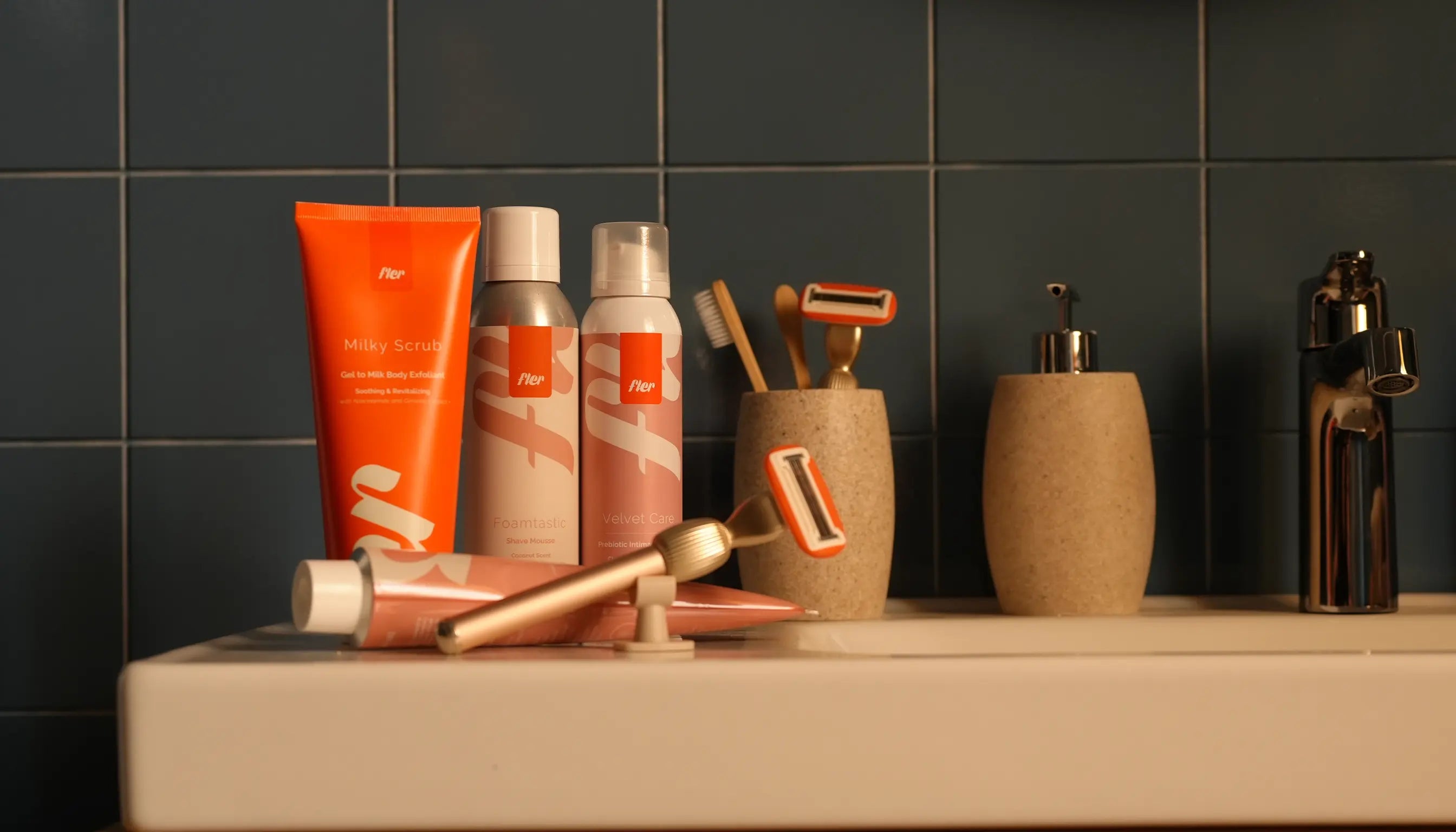
It might seem a little surprising to hear a razor brand talking about the freedom not to shave. But for us, that's always been exactly the point.
We're not here to convince you to shave. We want shaving, if you choose to do it, to feel like an act of self-care, not an obligation.
Our relationship with our bodies can change, just as our preferences, habits and different stages of life change.
And maybe that's part of what freedom really means: being able to change your mind without it saying anything about your worth.
You don't have to love every part of your body to respect it
Over the past few years, we've heard a lot about body positivity and body acceptance.
These are important conversations that have helped challenge many rigid beauty standards.
But there's another possibility that perhaps doesn't get talked about quite as much.
There will be days when you love how you look, days when you feel a little less confident, and others when you've got far more interesting things to think about.
And this brings us to something that really resonated with us during our conversation with Serenis: the goal doesn't necessarily have to be turning every insecurity into something we absolutely love.
It might be much more realistic to reach a point where we can think:
“This part of my body exists. It doesn't define my worth, and it doesn't have to take up all my mental space.”
We don't have to love everything about our bodies to treat them with respect.
And maybe that's where self-care really begins.
Not with the pressure to feel beautiful all the time or the constant pursuit of some “ideal” version of our bodies.
But with the freedom to care for our bodies without treating them like a project that constantly needs fixing.
With that scar, that wrinkle, that body hair, those stretch marks or whatever other feature we somehow learned, at some point along the way, to examine just a little too closely.
Shaving or not shaving isn't the point.
The point is being able to choose without letting that choice define your worth.
And on that, Fler and Serenis are definitely on the same page.
What about you? What do you think?